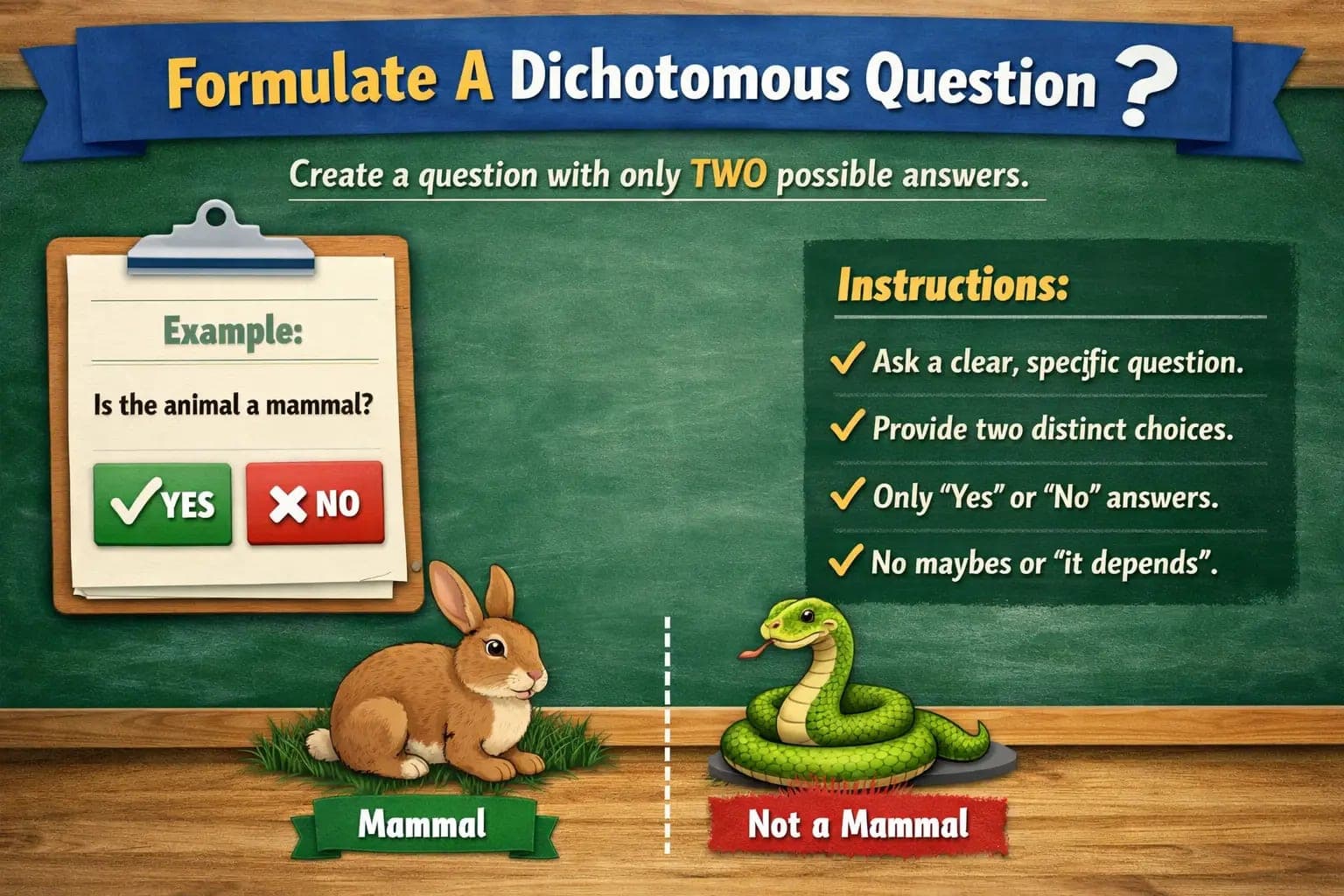
Learn how to create clear dichotomous questions with precise instructions. Improve surveys, research, and decision-making with practical examples.
Introduction
Dichotomous questions are among the simplest yet most powerful tools in surveys, research, and decision-making processes. These questions offer respondents only two possible answers, typically "Yes/No," "True/False," or "Agree/Disagree." While they may appear straightforward, crafting an effective dichotomous question requires careful consideration and precision.
In this comprehensive guide, we will explore how to formulate a dichotomous question along with clear accompanying instructions. You will learn best practices, common pitfalls, real-world examples, and actionable tips to ensure your questions are both effective and reliable.
What is a Dichotomous Question?
A dichotomous question is a type of closed-ended question that provides exactly two response options. It is commonly used in:
- Surveys
- Questionnaires
- Market research
- Academic studies
- User feedback forms
Key Characteristics
- Only two possible answers
- Simple and direct
- Easy to analyze
- Quick for respondents to answer
Examples
- Do you own a smartphone? (Yes/No)
- Have you used this product before? (Yes/No)
- Do you agree with the statement? (Agree/Disagree)
Importance of Accompanying Instructions
Even the simplest question can lead to confusion if not properly explained. Accompanying instructions provide clarity and ensure that respondents understand exactly how to answer.
Why Instructions Matter
- Prevent ambiguity
- Improve response accuracy
- Reduce bias
- Enhance data quality
Example Without Instruction
Question: Do you exercise regularly?
This leaves room for interpretation. What counts as "regularly"?
Example With Instruction
Instruction: Please answer based on your activities over the past 7 days.
Question: Did you exercise at least three times in the past week? (Yes/No)
This version is much clearer and more precise.
Steps to Formulate a Dichotomous Question
1. Define Your Objective
Before writing the question, clearly identify what you want to measure.
Ask yourself:
- What information do I need?
- How will the answer be used?
2. Use Clear and Simple Language
Avoid jargon, complex words, or technical terms unless necessary.
Example:
- Poor: Do you engage in cardiovascular physical activities?
- Better: Do you do activities like running or brisk walking?
3. Ensure Binary Nature
The question must strictly allow only two answers.
Correct:
- Do you own a car? (Yes/No)
Incorrect:
- Do you own a car, bike, or neither?
4. Avoid Double-Barreled Questions
Do not combine two questions into one.
Incorrect:
- Do you like coffee and tea? (Yes/No)
Correct:
- Do you like coffee? (Yes/No)
- Do you like tea? (Yes/No)
5. Add Precise Instructions
Provide context or conditions where necessary.
Crafting Effective Instructions
Instructions should be concise yet informative.
Best Practices
- Keep instructions short
- Place them before the question
- Use simple language
- Be specific about time frames or conditions
Example
Instruction: Please answer based on your experience in the last 30 days.
Question: Have you purchased any online products in the past month? (Yes/No)
Types of Dichotomous Questions
1. Yes/No Questions
The most common type.
Example:
- Do you use social media daily? (Yes/No)
2. True/False Questions
Often used in assessments.
Example:
- The Earth revolves around the Sun. (True/False)
3. Agree/Disagree Questions
Used in opinion-based surveys.
Example:
- I am satisfied with the service. (Agree/Disagree)
Real-World Examples
Example 1: Customer Feedback
Instruction: Please consider your most recent purchase.
Question: Were you satisfied with the product quality? (Yes/No)
Example 2: Employee Survey
Instruction: Answer based on your current role.
Question: Do you feel valued at your workplace? (Yes/No)
Example 3: Health Survey
Instruction: Answer based on the past 6 months.
Question: Have you experienced frequent headaches? (Yes/No)
Common Mistakes to Avoid
1. Ambiguity
Avoid vague terms like "often" or "regularly."
2. Leading Questions
Do not influence the respondent.
Incorrect:
- Don't you think this product is great? (Yes/No)
3. Lack of Context
Always include necessary instructions.
4. Overcomplication
Keep both question and instruction simple.
Advantages of Dichotomous Questions
- Easy to answer
- Quick data collection
- Simple analysis
- High response rates
Disadvantages
- Limited depth
- No nuance in responses
- May oversimplify complex issues
Practical Tips for Better Results
Tip 1: Test Your Questions
Conduct a pilot test to ensure clarity.
Tip 2: Use Consistent Format
Maintain uniformity across your survey.
Tip 3: Combine with Other Question Types
Use open-ended or multiple-choice questions for deeper insights.
Tip 4: Be Neutral
Avoid biased wording.
Tip 5: Keep It Relevant
Only ask questions that serve your objective.
Advanced Considerations
When to Use Dichotomous Questions
- When you need quick decisions
- When measuring presence/absence
- When simplicity is key
When NOT to Use Them
- When detailed opinions are required
- When multiple perspectives exist
Example Template
Here is a simple template you can use:
Instruction: [Provide context, timeframe, or condition]
Question: [Clear yes/no question]
Sample Applications
Market Research
- Identify customer preferences
- Measure brand awareness
Education
- Quick assessments
- Knowledge checks
Healthcare
- Symptom tracking
- Patient history
Conclusion
Formulating a dichotomous question with accompanying instruction is both an art and a science. While the structure is simple, the effectiveness depends on clarity, precision, and relevance. By following the steps outlined in this guide, you can create questions that yield accurate, actionable insights.
Remember:
- Keep questions simple and binary
- Provide clear instructions
- Avoid ambiguity and bias
- Test before deployment
With these best practices, you can significantly improve the quality of your surveys, research, and decision-making processes.
By mastering dichotomous questions, you equip yourself with a powerful tool that simplifies data collection while maintaining reliability and clarity.