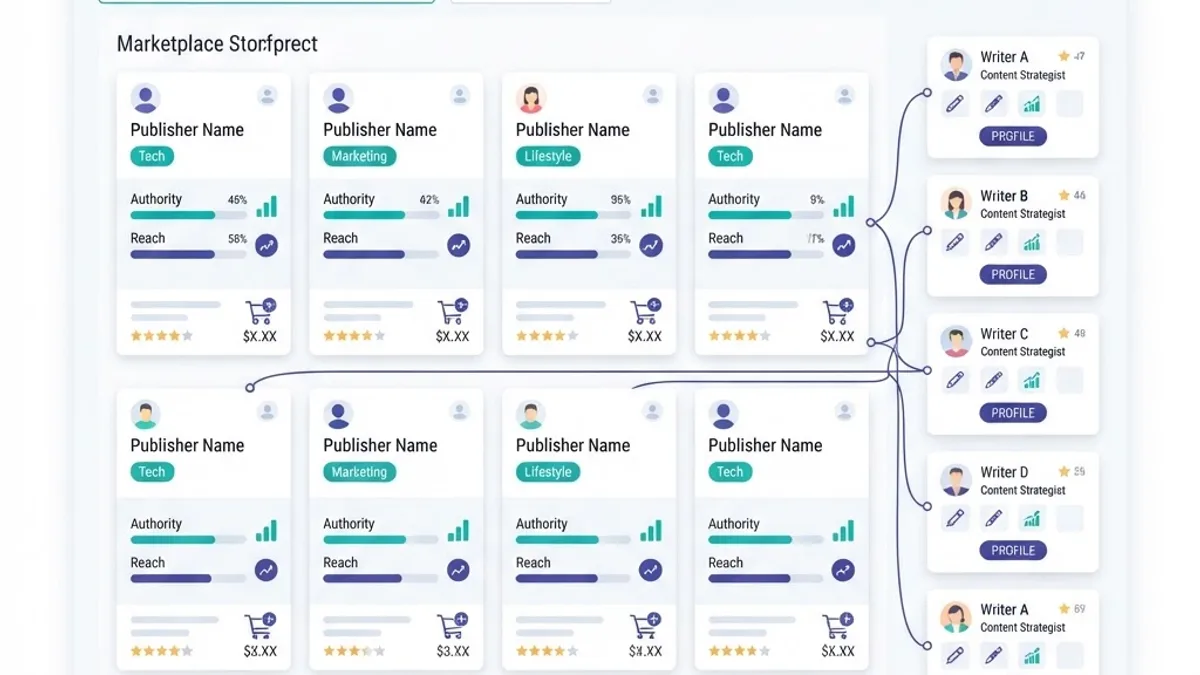
A practical guide to guest blog post marketplaces: how they work, what to check before you buy, and how to avoid low-quality links that hurt your SEO.
Introduction
A guest blog post marketplace is an online platform that connects brands and marketers who want backlinks with website owners who accept paid or contributed content. Instead of manually finding, vetting, and negotiating with each publisher, you browse a catalog of sites, filter by metrics, and order placements, all in one place.
This guide explains how guest blog post marketplaces work, their advantages and limitations, how to choose the right one, and how to use them safely so your link building strengthens your SEO rather than putting it at risk.
Table of Contents
- What a guest blog post marketplace is
- How marketplaces work
- Pros and cons of using a marketplace
- How to choose the right marketplace
- Evaluating sites within a marketplace
- Getting the best value from placements
- Marketplace versus manual outreach
- Frequently asked questions
- Conclusion
What a Guest Blog Post Marketplace Is
A guest blog post marketplace is essentially a matchmaking platform for link building. Publishers list their websites along with metrics and pricing, and buyers browse, filter, and purchase guest post placements. Many marketplaces also offer add-on services such as content writing, so you can order both the article and the placement together.
The core promise is efficiency. Finding quality sites through cold outreach is slow; a marketplace compresses weeks of prospecting into a few clicks. That convenience is why marketplaces have become a fixture in modern SEO.
How Marketplaces Work
While platforms differ, most follow a similar flow:
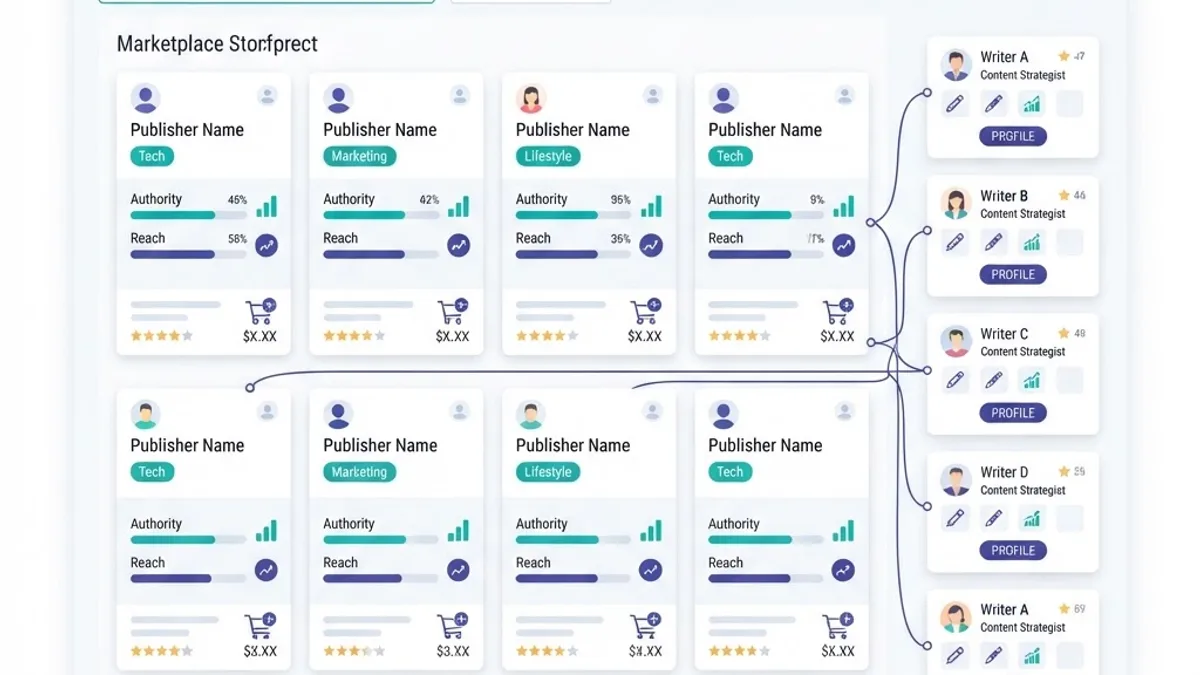
- Browse the catalog. Publishers are listed with metrics like domain authority, organic traffic, niche, and turnaround time.
- Filter and shortlist. You narrow options by relevance, metrics, and budget.
- Order the placement. You submit your article or request content creation, along with your target link and anchor text.
- Editorial review. The publisher reviews the content and requests edits if needed.
- Publication and reporting. The article goes live and you receive the URL.
Some marketplaces act as a managed middle layer, handling communication and quality control, while others simply facilitate the transaction.
Pros and Cons of Using a Marketplace
Marketplaces offer real benefits, but they are not without trade-offs.
Advantages
- Speed and scale. Secure multiple placements quickly without endless outreach emails.
- Transparent metrics. Compare sites side by side before you buy.
- Predictable pricing. Costs are listed upfront, making budgeting easier.
- Bundled services. Many platforms include content creation and reporting.
Limitations
- Quality varies. Some listed sites exist mainly to sell links and have thin content or fake traffic.
- Higher visibility to search engines. Popular link-selling sites may be flagged if they show unnatural outbound patterns.
- Less relationship building. Transactional placements lack the long-term partnerships that manual outreach can create.
- Disclosure requirements. Paid links must follow Google's rules on sponsored attributes.
Understanding these trade-offs helps you use marketplaces wisely rather than treating them as a shortcut to guaranteed rankings.
How to Choose the Right Marketplace
Not all marketplaces are equal. Evaluate any platform against these criteria.
Vetting Standards
The best marketplaces vet publishers for real traffic, genuine content, and editorial quality. Ask how sites are screened before they are listed.
Metric Accuracy
Confirm that traffic and authority figures come from reputable tools and are updated regularly. Inflated or outdated metrics lead to poor decisions.
Niche Coverage
A strong marketplace offers sites across many niches so you can find genuinely relevant placements rather than settling for loosely related ones.
Transparency
You should always know exactly which site your content will appear on before purchase. Hidden or "blind" placements are a warning sign.
Support and Guarantees
Look for clear policies on revisions, replacements if a link is removed, and responsive support. An experienced digital marketing partner can help you assess these factors objectively.
Evaluating Sites Within a Marketplace
Even on a reputable marketplace, you must evaluate individual sites. For each listing, check:
- Topical relevance to your brand and target page
- Organic traffic and whether it is trending up or down
- Content quality by reading a few published articles
- Outbound link patterns to spot sites that sell too many links
- Spam signals and the overall health of the domain
A relevant site with modest but real traffic usually beats a high-authority site with no genuine audience. Prioritize placements where your link will sit inside content readers actually value.
Getting the Best Value From Placements
To maximize your return on every purchase:
Provide Genuinely Useful Content
Even in a marketplace, the article should help readers. High-quality content earns engagement and makes your link look natural. A professional content writing service can produce pieces that publishers accept without heavy edits.
Use Natural Anchor Text
Avoid exact-match keyword anchors on every link. Mix branded, descriptive, and natural-phrase anchors to keep your profile healthy.
Link to the Right Pages
Deep links to genuinely relevant resources often outperform generic homepage links. Match the destination to the article's topic.
Send Traffic to a Strong Destination
When readers click through, they should land on a fast, credible page. Professional website design and reliable back-end web development ensure that referral traffic converts.
Track Performance
Monitor rankings and referral traffic per placement, then reinvest in the site types and topics that deliver.
Marketplace Versus Manual Outreach
Both approaches have a place in a mature strategy:
- Marketplaces win on speed, convenience, and predictable pricing. They suit teams that need volume and efficiency.
- Manual outreach wins on relationship building, exclusivity, and sometimes higher-quality editorial links. It suits brands pursuing flagship placements.
The smartest strategy often blends the two: use a marketplace for efficient, relevant placements and manual outreach for premium, relationship-driven opportunities. This diversity also keeps your backlink profile looking natural.
Red Flags That Signal a Low-Quality Marketplace
Because marketplaces vary so widely, learning to spot warning signs protects your budget and your site. Be cautious when a platform lists thousands of sites but offers little detail about how they are vetted. High volume with low transparency usually means many listings are link-selling sites with thin content and inflated metrics.
Other red flags include pressure to buy large bulk packages at steep discounts, refusal to reveal the exact site before purchase, metrics that seem far higher than the site's visible engagement, and a catalog dominated by generic "general" blogs that publish about every topic under the sun. Sites that accept content on finance, health, pets, and gambling all at once rarely have genuine authority in any of them.
A trustworthy marketplace, by contrast, is upfront about its screening process, shows real traffic data from recognized tools, and offers replacement guarantees if a link is removed. When in doubt, order a single test placement before committing to a larger campaign, and evaluate the result closely.
A Simple Framework for Marketplace Buying Decisions
To keep your purchases disciplined, apply a consistent scoring framework to every listing. Rate each candidate site on relevance to your niche, genuine organic traffic, content quality, and the health of its outbound link profile. Only buy placements that score well on all four dimensions rather than being swayed by a single impressive metric.
It also helps to set a monthly link budget and a target mix in advance, for example a majority of placements on tightly relevant sites and a smaller portion on broader but still credible publications. This planning prevents impulse purchases and keeps your backlink profile looking natural. Pair the links you buy with a fast, credible destination supported by professional website design, so the referral traffic you earn has the best chance of converting into customers.
Frequently Asked Questions
Are guest blog post marketplaces safe for SEO?
They can be, when you choose vetted platforms, select relevant sites with real traffic, publish genuinely useful content, and follow disclosure rules. Risk comes from spammy sites, duplicate content, and manipulative anchors.
Do I need to disclose paid guest post links?
Yes. Google requires paid links to use rel="sponsored" or rel="nofollow." Following this keeps your link building compliant.
How much do marketplace placements cost?
Prices vary widely based on the site's authority, traffic, and niche, ranging from modest fees to premium rates for high-traffic sites. Focus on value per placement rather than the lowest price.
Can I use my own content on a marketplace?
Usually yes. Many marketplaces let you supply your own article, which gives you full control over quality and messaging.
How do marketplaces differ from private blog networks?
Reputable marketplaces list independent, genuinely trafficked sites. Private blog networks are interlinked, low-value sites built solely for links and carry a high penalty risk. Avoid the latter.
How many placements should I buy at once?
Grow your link profile steadily rather than in sudden bursts. A gradual, consistent pace looks more natural to search engines.
Conclusion
A guest blog post marketplace can dramatically speed up link building, but only when you use it with discipline. Choose vetted platforms, evaluate each site for relevance and real traffic, publish genuinely helpful content, follow disclosure rules, and grow your profile steadily.
Blend marketplace efficiency with selective manual outreach, point your links to a strong website, and track what works. If you want expert help selecting placements, producing content, and managing your campaigns, partner with a team that handles outreach, content, and WordPress development end to end.
Ready to scale your link building? Shortlist a reputable marketplace, define your relevance criteria, and start ordering placements that genuinely strengthen your authority.