In-office whitening costs $400–$1,000. See what the premium actually buys, how it compares with trays and strips, and who genuinely benefits most.
Last updated: July 23, 2026
Introduction
Professional in-office teeth whitening typically costs between $400 and $1,000 per session. Meanwhile, the drugstore sells whitening strips for $30, and your dentist offers take-home trays for around $250. So the question practically asks itself: is in-office whitening worth the price?
The honest answer is: it depends on what you are buying it for. In-office whitening is not simply "stronger strips." It is a fundamentally different service — faster, safer for certain patients, more predictable, and supervised — and for some people those differences justify every dollar. For others, cheaper routes reach nearly the same destination with more patience. This guide breaks down exactly what you get for the premium price, who benefits most, the real cost-per-shade math, and how to decide which route fits your teeth, timeline, and budget.
Table of Contents
- What in-office whitening actually involves
- What you're paying for: the real differences
- In-office vs. take-home trays vs. strips
- The results: what to realistically expect
- Who benefits most from in-office whitening
- Who should skip it
- The cost-per-shade math
- How to maximize your investment
- Frequently asked questions
- Conclusion
What In-Office Whitening Actually Involves
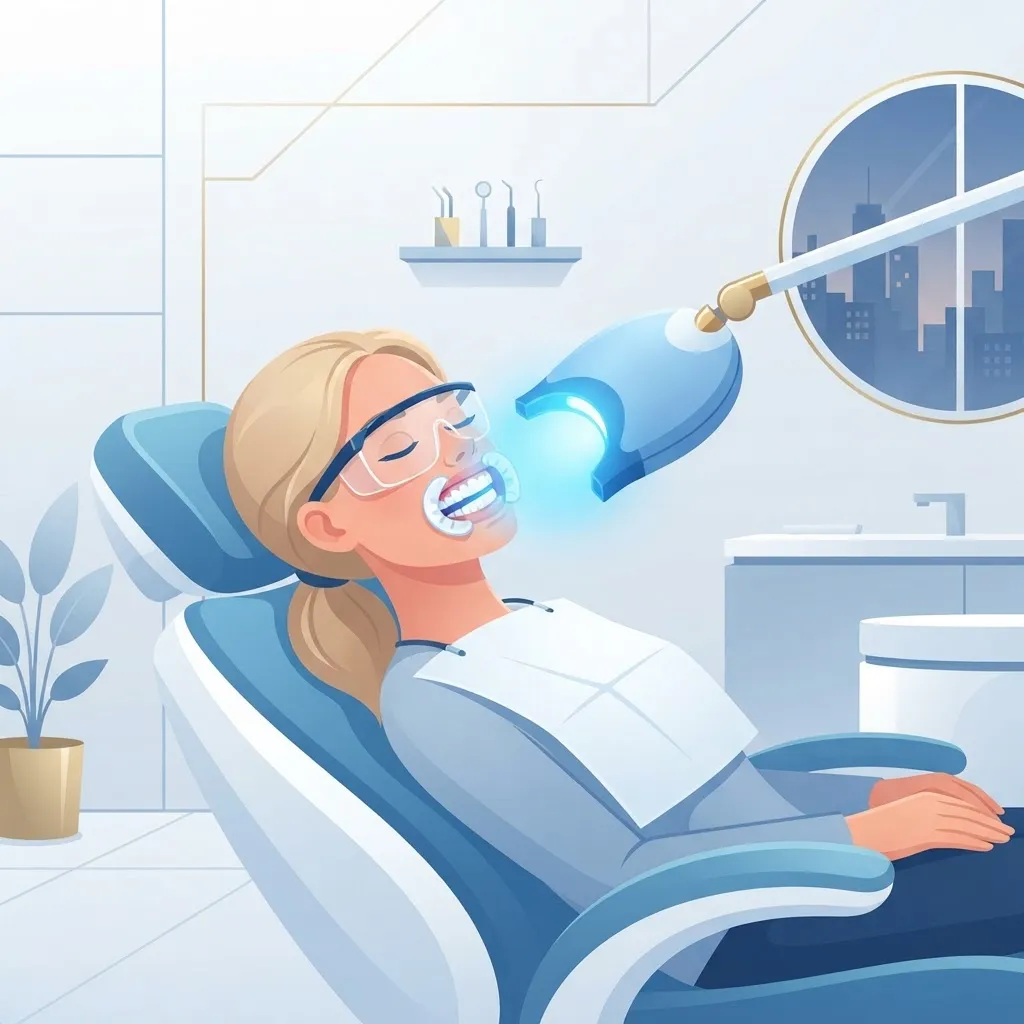
A typical professional whitening appointment runs 60 to 90 minutes and follows a consistent structure:
- Examination and shade documentation. The dentist confirms your teeth and gums are healthy enough to whiten and records your starting shade.
- Cleaning. Surface plaque and debris are removed so the gel contacts enamel evenly.
- Gum protection. A liquid dam — a resin barrier — is applied along the gumline and cured. This step is a major differentiator: it allows the use of high-concentration peroxide that would burn unprotected gum tissue.
- High-concentration gel application. Professional gels contain 25–40% hydrogen peroxide, versus roughly 6–14% peroxide equivalents in over-the-counter strips.
- Activation and timed cycles. The gel works in two to four cycles of 15–20 minutes, sometimes with an LED light. (Worth knowing: research on whether the light itself adds much benefit is mixed — the concentration and supervision are the real advantages.)
- Final shade comparison and fluoride treatment. Most patients leave visibly whiter, with before-and-after shade documentation.
Some practices add custom take-home trays for touch-ups, which meaningfully extends the value of the session.
What You're Paying For: The Real Differences
The price premium buys five concrete things:
Speed
One appointment. Most patients gain three to eight shades in a single visit — a result that takes strips two to four weeks and trays one to two weeks to approach.
Concentration
The 25–40% hydrogen peroxide used in-office is only legal and safe under professional supervision with gum isolation. Higher concentration means deeper, faster stain breakdown within the enamel.
Supervision and safety
A professional checks for cavities, cracks, exposed roots, and failing restorations before whitening — all of which can turn an unsupervised whitening session painful. Mid-procedure, the dentist manages any sensitivity immediately. This supervision matters even more for patients with special considerations; for instance, pregnant patients are generally advised to postpone whitening, and a dentist visit is where that guidance actually happens.
Predictability
Uneven DIY whitening — white spots, streaks, splotchy results from poorly fitting strips — is a common complaint. Professional application is uniform, and the dentist can manage teeth that respond unevenly.
Accountability
If something goes wrong or results disappoint, you have a professional relationship and often a documented shade guarantee. With a $30 box of strips, you have a receipt.
In-Office vs. Take-Home Trays vs. Strips
| Factor | In-office | Custom take-home trays | OTC strips |
|---|---|---|---|
| Typical cost | $400–$1,000 | $200–$400 | $20–$60 |
| Peroxide strength | 25–40% HP | 10–22% CP | ~6–14% HP equivalent |
| Time to full result | 1 visit | 1–2 weeks | 2–4 weeks |
| Shade improvement | 3–8 shades | 3–6 shades | 1–3 shades |
| Evenness | Excellent | Very good | Variable |
| Sensitivity management | Immediate, professional | Good (dentist-guided) | Self-managed |
| Longevity of result | 1–3 years* | 1–2 years* | 4–6 months* |
*With good habits; results vary by diet, smoking, and maintenance.
A noteworthy insight from this comparison: custom take-home trays from your dentist are the value sweet spot for many patients — professional supervision and near-professional results at a mid-tier price, just slower. The strongest overall protocol, used by many cosmetic dentists, combines both: an in-office session for the jump start, plus trays for maintenance.
The Results: What to Realistically Expect
Setting expectations honestly:
- Yellow-toned staining responds best. Coffee, tea, wine, and age-related yellowing are peroxide's ideal targets.
- Gray or blue-toned discoloration responds less, especially tetracycline staining, which may require multiple sessions or restorative alternatives like veneers.
- Restorations do not whiten. Crowns, veneers, and composite bonding stay their original color — a critical planning point if you have visible dental work. Whiten first, then match new restorations to the result.
- Results are not permanent. Teeth re-stain gradually based on diet and habits. Expect one to three years before wanting a touch-up, less for heavy coffee drinkers or smokers.
- Temporary sensitivity is common. Roughly half of patients experience mild cold sensitivity for 24–72 hours after in-office whitening. It resolves on its own and is managed well with desensitizing toothpaste.
If a whiter smile is part of a larger plan — say, before bonding or veneer work — sequence matters, and this is another argument for doing it under one professional roof.
Who Benefits Most From In-Office Whitening
In-office whitening is clearly worth the price for:
- People with an event deadline. Wedding, graduation, job interviews, reunion — when you need results this week, nothing else competes.
- Heavy staining that OTC products couldn't touch. Higher concentration reaches deeper intrinsic staining.
- Patients with sensitive teeth or gum recession. Counterintuitively, supervised whitening is often the safest option for sensitive patients, because the dentist isolates vulnerable areas and manages sensitivity in real time.
- People who tried strips and got streaky results. Professional application solves evenness problems.
- Anyone whitening before restorative work, so new crowns or bonding can be matched to the final shade.
- People who value one-and-done convenience over saving a few hundred dollars.
Who Should Skip It
In-office whitening is probably not worth it for:
- Mild staining and no deadline. Custom trays or quality strips will get you close for far less money.
- Gray/tetracycline discoloration, where even professional whitening underdelivers — ask about veneers or bonding instead.
- Extensive visible restorations, which won't change color; whitening may worsen mismatch.
- Untreated decay or gum disease — treat health first, cosmetics after.
- Patients under 16 and pregnant or nursing patients, per standard professional guidance.
The Cost-Per-Shade Math
Here is a practical way to think about value. Suppose in-office whitening costs $600 and delivers six shades: that is $100 per shade, delivered in one day, evenly, with safety supervision. Custom trays at $300 delivering five shades cost $60 per shade but require two weeks of nightly compliance. Strips at $40 delivering two shades cost $20 per shade but often with unevenness and a ceiling on results.
Viewed this way, the premium for in-office whitening is really a payment for time, ceiling, and certainty. If those three things matter to your situation, the math favors the dental chair. If they don't, the math favors patience.
One more financial note: whitening is purely cosmetic, so dental insurance will not contribute — but many practices run seasonal promotions, bundle whitening with new-patient exams, or include it in membership plans. It is genuinely worth asking. Practices compete hard for cosmetic patients, which is why so many invest in polished websites and active social media promotion — and those channels are exactly where whitening deals get announced.
How to Maximize Your Investment
Protect your results with these habits:
- Follow the "white diet" for 48 hours post-treatment: avoid coffee, tea, red wine, curry, berries, and tobacco while enamel pores are open.
- Adopt the straw habit for iced coffee and other staining drinks.
- Rinse with water after staining foods and drinks.
- Use a whitening toothpaste 2–3 times weekly (not daily — they are abrasive) to slow surface re-staining.
- Get take-home trays for maintenance. A single night of tray wear every one to two months keeps results near peak indefinitely.
- Keep six-month cleanings, which remove the surface stains that make teeth look duller than their actual shade.
Frequently Asked Questions
How much does in-office teeth whitening cost?
Typically $400 to $1,000 per session in the United States, depending on region, system used, and whether take-home maintenance trays are included. Averages cluster around $500–$650.
How long does professional whitening last?
Generally one to three years before a noticeable rebound, depending on coffee, tea, wine, tobacco, and hygiene habits. Periodic tray touch-ups can extend results indefinitely.
Is in-office whitening safe?
Yes — under professional supervision, it is the safest way to use high-concentration peroxide. Gum tissue is physically isolated, teeth are pre-screened for problems, and sensitivity is managed in real time.
How many shades whiter will my teeth get?
Most patients gain three to eight shades in a single session. Yellow-toned stains respond best; gray-toned discoloration improves less predictably.
Does the LED light actually do anything?
Evidence is mixed. Some studies show modest acceleration; others find the gel concentration does virtually all the work. Choose a provider based on their protocol and experience, not the presence of a light.
Will whitening damage my enamel?
No. Peroxide whitening at professional concentrations, properly applied, does not soften or structurally damage enamel. Temporary sensitivity reflects fluid movement in dentin tubules, not damage.
Why won't my crowns and fillings whiten?
Dental materials — porcelain, zirconia, composite — are color-stable and unaffected by peroxide. If restorations are visible when you smile, plan whitening first and restoration replacement or matching after.
Is professional whitening better than Zoom or laser whitening ads I see?
Zoom is a brand of in-office whitening; "laser whitening" is a marketing term for light-activated systems. They are all variations of professional high-concentration peroxide treatment — the dentist's skill and protocol matter more than the brand name.
Conclusion
Is in-office whitening worth the price? For the patient with a deadline, deep staining, sensitivity concerns, previous DIY disappointments, or upcoming restorative work to color-match — yes, decisively. You are paying for speed, a higher results ceiling, evenness, and professional safety that cheaper options structurally cannot offer.
For the patient with mild yellowing, a flexible timeline, and disciplined habits, custom take-home trays deliver most of the result at half the price, and even quality strips can satisfy modest goals. The smartest move is a whitening consultation: shade assessment, honest prediction of your teeth's response, and a quote — then run the cost-per-shade math for your own smile.
Your next step: Ask your dentist for a shade assessment and a written estimate for both in-office whitening and custom trays. Ten minutes of comparison now ensures your whitening budget — whatever its size — buys the brightest possible result.