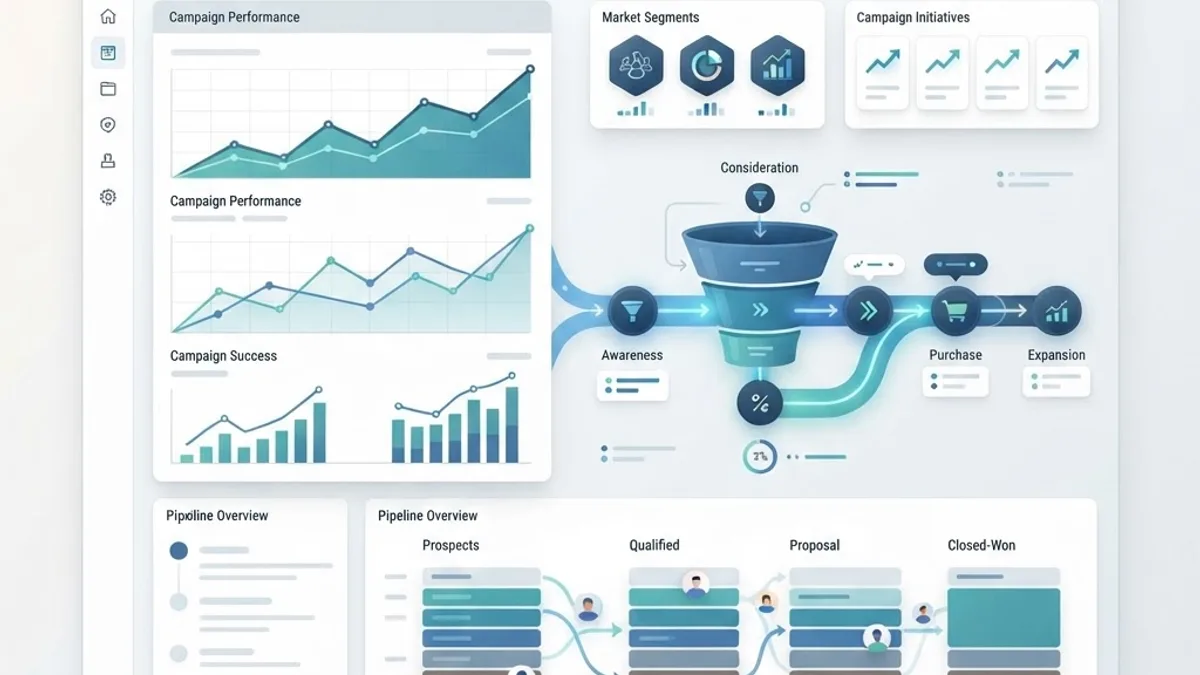
An analytical look at MeridianLink marketing campaigns, website changes, and go-to-market initiatives in 2026, and the B2B fintech lessons marketers can apply.
Last updated: July 29, 2026
Introduction
MeridianLink is a well-known provider of software for banks, credit unions, and other financial institutions, powering everything from loan origination to consumer lending and data verification. Because it operates in a competitive B2B fintech space, its marketing campaigns, website changes, and go-to-market (GTM) initiatives in 2026 offer a useful case study for anyone building a modern software brand.
This article takes an analytical look at how a company like MeridianLink approaches marketing and GTM in 2026, the kinds of website changes that signal a maturing strategy, and, most importantly, the practical lessons you can apply to your own B2B or fintech marketing. Rather than reciting unverified specifics, we focus on observable patterns and proven frameworks so you leave with ideas you can actually use.
Table of Contents
- Understanding MeridianLink's market position
- What modern B2B fintech marketing campaigns look like
- Website changes that signal GTM maturity
- Go-to-market initiatives shaping 2026
- Lessons B2B marketers can apply
- Measuring the impact of GTM changes
- Building a GTM-ready website
- Frequently asked questions
- Conclusion
Understanding MeridianLink's Market Position
To interpret any company's marketing moves, you first have to understand who it sells to. MeridianLink's customers are financial institutions, meaning long sales cycles, multiple stakeholders, strict compliance requirements, and high switching costs. In that environment, marketing cannot rely on impulse. It must build trust, demonstrate expertise, and nurture prospects over months.
That reality shapes everything downstream. Campaigns lean on education and credibility rather than flashy promotion. Website changes tend to emphasize clarity, proof, and self-service research. And GTM initiatives are usually about aligning product, sales, and marketing around specific segments such as credit unions, mortgage lenders, or consumer lending teams. Keeping this context in mind makes the patterns below far easier to understand.
What Modern B2B Fintech Marketing Campaigns Look Like
B2B fintech campaigns in 2026 share several recognizable traits, whether they come from MeridianLink or any serious competitor.
Account-based and segment-specific messaging
Instead of one generic message, mature marketers tailor campaigns to distinct audiences. A campaign aimed at credit unions speaks to member experience and community lending, while one aimed at mortgage lenders emphasizes speed, compliance, and automation. This segment-first approach improves relevance and conversion.
Education-led demand generation
Whitepapers, webinars, benchmark reports, and product explainers do the heavy lifting. The goal is to help buyers understand a problem deeply, positioning the vendor as the obvious expert when it is time to buy. Strong content writing and digital marketing are the engine behind this motion.
Proof and trust signals
Case studies, ROI calculators, security and compliance documentation, and customer testimonials reduce perceived risk. In fintech, trust is the currency that closes deals.
Multi-channel orchestration
Email nurture, LinkedIn, paid search, retargeting, industry events, and partner marketing work together rather than in silos. A single campaign theme is expressed consistently across every channel.
Website Changes That Signal GTM Maturity
A company's website is the clearest public record of its marketing priorities. When you see structural website changes at a firm like MeridianLink, they usually reflect deeper strategic shifts. Watch for these signals:
- Solution-based navigation. Menus reorganized around customer problems and segments (for example, "consumer lending" or "credit unions") rather than internal product names indicate a buyer-first, GTM-aligned approach.
- Clearer conversion paths. More prominent "request a demo," "talk to sales," and "get pricing" calls to action show a focus on measurable pipeline rather than passive brand awareness.
- Expanded resource hubs. Growing libraries of guides, reports, and webinars point to an education-led demand strategy.
- Performance and technical upgrades. Faster load times, cleaner code, and better mobile experiences improve both SEO and conversion. This is where quality front-end web development and reliable back-end web development directly affect marketing outcomes.
- Personalization. Content that adapts to industry, role, or referral source shows an investment in account-based marketing.
If you monitor a competitor's site over time, these changes tell a story about where their GTM strategy is heading.
Go-to-Market Initiatives Shaping 2026
Go-to-market strategy is the plan for how a company brings a product to its target customers and grows revenue. Several GTM themes are prominent across B2B fintech in 2026, and they help frame what a company like MeridianLink is likely prioritizing.
Product-led and sales-led hybrids
Even in enterprise fintech, buyers increasingly expect self-service research and interactive product experiences before they ever talk to sales. The winning approach blends product-led discovery with a strong sales motion for complex deals.
Platform and ecosystem positioning
Rather than selling isolated tools, vendors position themselves as connected platforms that integrate across a customer's tech stack. GTM messaging emphasizes interoperability, data, and long-term partnership.
Vertical specialization
Speaking the specific language of credit unions, community banks, or mortgage lenders beats generic "financial software" messaging. Vertical GTM plays deepen relevance and shorten sales cycles.
AI-enabled workflows
Automation and artificial intelligence increasingly feature in both the product and the marketing, from smarter lending decisions to AI-assisted content and lead scoring. Positioning around responsible, compliant AI is a common 2026 theme.
Lessons B2B Marketers Can Apply
You do not need MeridianLink's budget to apply its playbook. Here are the transferable lessons:
- Segment before you scale. Identify your two or three most valuable customer types and build tailored messaging for each before spreading yourself thin.
- Lead with education. Teach your market something genuinely useful. Authority earned through helpful content converts better than promotion.
- Make trust visible. Publish case studies, security details, and clear pricing signals. Reducing perceived risk is often the fastest way to lift conversion.
- Align your website with your GTM. Your navigation, calls to action, and resources should mirror how your buyers actually make decisions.
- Treat your site as a growth asset, not a brochure. Speed, structure, and SEO are marketing infrastructure, not afterthoughts.
Measuring the Impact of GTM Changes
Any marketing or website change is only as good as your ability to measure it. Set up measurement before you launch, not after. Focus on:
- Pipeline and conversion metrics: demo requests, qualified leads, and opportunity-to-close rates by segment.
- Website engagement: organic traffic growth, time on key pages, resource downloads, and conversion rate on high-intent pages.
- Content performance: which topics generate the most qualified engagement, so you can double down.
- Attribution: understanding which channels and campaigns actually influence closed revenue.
Run changes as deliberate experiments with clear baselines. When you redesign navigation or launch a campaign, compare against the prior period and isolate variables so you know what actually drove the result. Ongoing website maintenance and support keeps your measurement infrastructure and site performance reliable over time.
Building a GTM-Ready Website
If the MeridianLink example inspires you to modernize your own site, prioritize these foundations:
- Buyer-first architecture organized around problems and segments.
- Fast, accessible, mobile-friendly performance that supports SEO and conversion.
- A robust resource hub that fuels education-led demand generation.
- Clear, low-friction conversion paths for demos, pricing, and sales contact.
- A flexible CMS so marketing can publish and iterate without engineering bottlenecks, which is where solutions like WordPress development or a modern Next JS web development stack shine.
A GTM-ready website turns marketing strategy into measurable pipeline, which is ultimately the point of every campaign and website change discussed here.
The Role of Brand in a Trust-Driven Category
It is tempting to treat B2B fintech marketing as purely rational, a matter of features, integrations, and price. In reality, brand plays an enormous role precisely because the stakes are so high. When a financial institution chooses a lending or origination platform, it is making a multi-year bet with regulatory, operational, and reputational consequences. In that context, a strong, credible brand is not a vanity project; it is risk reduction for the buyer.
This is why mature fintech marketers invest in consistent visual identity, authoritative content, and a polished digital experience. Every touchpoint, from a conference booth to a pricing page, either reinforces or erodes the perception that the vendor is a safe, competent partner. Companies that treat brand as an afterthought often find their sales teams working twice as hard to overcome doubt that better marketing could have preempted. The lesson for any B2B marketer is that trust is built cumulatively, across dozens of impressions, long before a prospect ever fills out a demo form.
Aligning Sales and Marketing Around the Buyer
Perhaps the most important GTM shift underway in 2026 is the deepening alignment between sales and marketing teams. In categories with long, multi-stakeholder sales cycles, friction between these functions quietly kills deals. Marketing generates interest, but if the handoff to sales is clumsy or the messaging shifts abruptly, prospects sense the disconnect and hesitate.
The strongest go-to-market organizations operate from a shared definition of the ideal customer, a common set of messages, and unified data about where each account sits in its journey. Marketing supplies sales with relevant content and warm, well-qualified leads, while sales feeds real conversations back into marketing to sharpen targeting and messaging. This closed loop is far more effective than either team optimizing in isolation, and it is a discipline any company can adopt regardless of size. When your website, campaigns, and sales conversations all tell the same coherent story, buyers move through the funnel with far less friction.
Frequently Asked Questions
What does GTM mean in marketing? GTM stands for go-to-market: the strategy a company uses to bring a product to its target customers, including positioning, messaging, channels, pricing, and the sales motion that turns interest into revenue.
Why do B2B fintech companies change their websites so often? Website changes usually reflect evolving GTM strategy, such as new segment targeting, clearer conversion paths, better performance for SEO, or expanded resources to support education-led demand generation.
What makes fintech marketing different from other B2B marketing? Fintech marketing must navigate long sales cycles, strict compliance, and high trust requirements. Campaigns emphasize education, proof, and credibility more than promotion or urgency.
How can I tell what a competitor's GTM strategy is? Study their website navigation, calls to action, resource libraries, messaging by segment, and campaign themes across channels. These public signals reveal who they target and how they sell.
Do I need a big budget to apply these strategies? No. Segment-specific messaging, education-led content, visible trust signals, and a GTM-aligned website are achievable at any scale. The principles matter more than the budget.
How do I measure whether a GTM change worked? Define baselines first, then track pipeline metrics, conversion rates on high-intent pages, content performance, and revenue attribution. Treat each change as a controlled experiment.
Conclusion
Whether or not you ever compete with MeridianLink directly, its approach illustrates how modern B2B fintech marketing works in 2026: segment-specific campaigns, education-led demand generation, visible trust, and websites engineered to convert. The website changes and GTM initiatives you can observe from the outside are simply the visible tip of a disciplined, buyer-first strategy underneath.
Apply the same principles, segment your audience, lead with genuine expertise, align your website with your buyers' journey, and measure everything, and you can compete far above your weight class.
Ready to turn your GTM strategy into a high-performing website and campaigns? Explore our digital marketing and web development services and build a growth engine your competitors will study.