200 Ton Alligator Shear: What It Cuts, and What to Check Before You Buy
What a 200 ton alligator shear cuts, the four numbers to check before you buy, and the questions to ask before you pay.
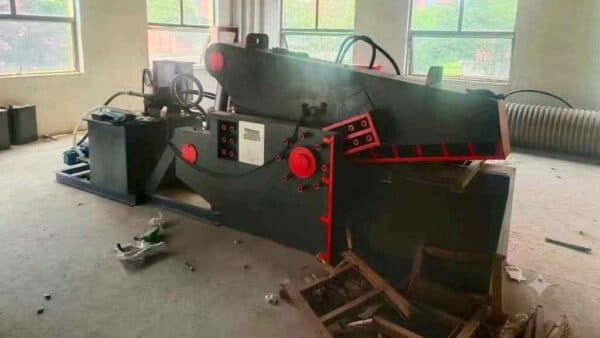
A 200 ton alligator shear sits in the middle of the range. It is strong enough for rebar and light sections, still cheap to run, and small enough to fit a yard that has no room for a gantry. Before you buy one, check the four numbers that decide whether it earns its floor space.
What Does 200 Tons Actually Mean?
Two hundred tons is cutting force, not machine weight. It is the force the jaw closes with, and it decides the thickest piece the machine can bite through. The jaw opening decides what fits in the first place, and the blade decides how clean the cut is and how long the edge lasts. A buyer who shops on tonnage alone can end up with a strong machine that still cannot take the pieces the yard actually handles. Read the tonnage together with the jaw and the blade, not instead of them.
Four Important Specifications to Check
A 22 kW motor is enough for this size. Smaller motors stall on thick rebar; bigger ones only add to the power bill.
Blades at 48–56 HRC hold an edge on mixed scrap without chipping. Softer steel dulls in a week; harder steel can crack.
The jaw takes plate up to 25 mm. If your regular stock is thicker, you are shopping in the wrong tonnage.
Six to ten cuts a minute sounds slow until you count the handling. One operator, one piece at a time, 1.5 to 3.0 tons an hour — that is the real throughput of this size.
Where Does a 200 Ton Alligator Shear Fit in a Scrap Yard?
Rebar yards, demolition offcuts, small mixed piles. The machine earns its keep on the light pile and leaves the heavy plate to the gantry.
If most of your scrap is HMS plate over 25 mm, skip this size entirely and look at a gantry shear instead. Yards that buy one usually keep it even after they add a gantry. It becomes the second machine, cutting the light pile while the big shear takes the heavy work, and the yard stops paying gantry time for pieces an alligator could have handled.
How to Operate and Maintain a 200 Ton Alligator Shear
The work is one operator and one piece at a time. Feed the piece, step on the pedal, pull the cut length out.
The blades bolt on, so a dull edge is a swap, not a rebuild, and the machine is back cutting the same day. Keep the jaw clean and check the blade gap when the cut starts to drag.
A 200-ton machine does not need a crew or a line. It needs a flat spot on the floor, a power supply, and somebody feeding it.
What to Ask Before Buying a 200 Ton Alligator Shear
Ask for a load-test video from the factory floor before the machine ships. Ask how spare blades ship — ours go within five working days — and what the blade steel actually is, not just the hardness number.
Ask for the jaw opening and the blade length as well, so you can check your longest regular piece fits before the machine arrives. A seller who cannot answer those questions is selling you a picture, not a machine.
Is a 200 Ton Alligator Shear the Right Choice?
Two hundred tons is not a big machine. That is the point. It does one job, it does it all day, and it costs less to run than the truck that feeds it.
Related Blogs
- Technology
 2 min read
200 Ton Crocodile Shear: The Same Machine Under a Different Name
A crocodile shear is the same machine as a 200-ton alligator shear. Learn where each name is used and the five checks to run before buying.
LLeon Li0 - Technology
 3 min read
The Role of Antibodies in Modern Biotechnology Research
Explore the importance of histone H4-K16 acetylation, specialized antibodies, and their role in modern biotechnology and epigenetics research.
 AbTriva4
- Technology
 2 min read
What Makes a Scrap Metal Shear Last? Four Parts Worth Checking Before You Buy
Check four parts before buying a scrap metal shear: blades, cylinders, power and controls, and the 72-hour factory test.
LLeon Li3